Baseline Pricing, Card-and-Lane Workflow Visualization

Role
UX Designer (collaborative design)
Team
Collaboration with a UX designer, product, operations leadership, and procurement stakeholders.
Scope
Workflow visualization · Card design · Information hierarchy · Interaction patterns
Timeline
2 Weeks

Project Overview
The Baseline Pricing platform is being designed to support high-volume procurement work, where teams compare pricing across a large number of vendors. Right now, most of that process still happens in Excel across multiple files, with no single place to review pricing trends, filter data, or compare vendors and available quantities side by side.
Expected Outcome
The expected outcome is a faster and more structured procurement workflow where teams can compare options more confidently, prioritize the right opportunities, and move purchasing decisions forward more efficiently. This work is being done in close collaboration with another designer, along with procurement and operations teams.
Goal
The goal with BLP is to make procurement workflows easier to navigate. A card-and-lane layout helps teams quickly scan and compare vendors, while filtering narrows large datasets down to the most relevant opportunities. Each card surfaces key details like pricing per part, available quantities, historical pricing, and invoice trends in one place.
Problem
The workflow has also been pretty fragmented. Teams constantly move back and forth between reviewing data, comparing options, and creating RFQs or RFCs. Without a connected workflow, it becomes harder to evaluate vendors properly or negotiate effectively, which can ultimately drive costs higher.
Team
This work is being done in close collaboration with another designer, along with procurement and operations teams.
Impact
By making vendor comparisons clearer and exposing pricing trends over time, the platform creates a stronger foundation for smarter purchasing decisions and better negotiation opportunities. Once in production, BLP is expected to contribute to meaningful cost savings for the company by improving how pricing decisions are evaluated and how vendors are compared at scale.
Design Focus
This project centers on a single, high-impact design surface: the pricing card. The challenge was not visual styling, but:
-
Defining the right information hierarchy
-
Determining what belongs at each level of attention and
-
How users move from rapid scanning to confident decision-making without losing context
Key Design Challenges
-
Pricing data was high-volume and multi-dimensional, spanning vendors, contracts, transactions, and trends
-
Users needed to identify risk and opportunity quickly, not analyze every item deeply
-
Existing table-based views made it difficult to prioritize work or compare items
-
The workflow needed to scale as product volume and pricing complexity increased
Product High-Level Ecosystem

Card + Lane Workflow
.png)
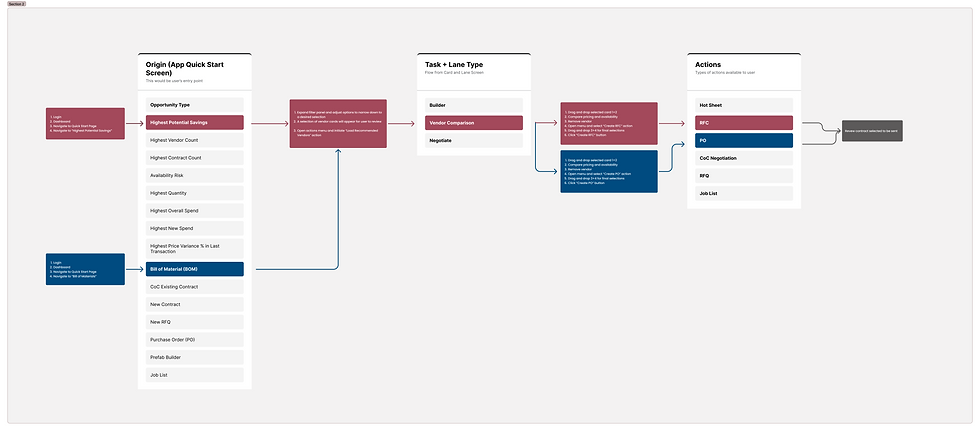
This recording shows the interaction flow starting from the Quick Start screen, which acts as the main entry point for procurement actions. From there, users can select a workflow based on their task and move directly into the next steps without needing to navigate across multiple screens.
This recording shows how the card-and-lane experience works and highlights some of the core interactions built into the workflow. Features like the collapsible filter panel, expandable cards, and on-demand details help users review more information directly from the same screen, reducing the need to constantly move back and forth between pages.
Design Strategy and Key Decisions

1. Card-and-Lane Structure for Prioritization
Cards were organized within lanes to reflect workflow state and priority, allowing users to visually group and sequence work without relying on filters or manual sorting.
This structure supports rapid scanning while preserving flexibility as pricing scenarios change.

Collapsed View
2. Strong Information Hierarchy in the Collapsed State
The collapsed card surfaces only the most decision-critical signals:
-
Product identity and manufacturer
-
Pricing risk or opportunity indicators
-
Coverage and volume context
-
Directional pricing trends
This allows users to answer “Is this worth attention?” in seconds.

3. Progressive Disclosure via Expandable Cards
Expanding a card reveals detailed transaction-level data directly within the workflow, eliminating the need to navigate away or open separate views.
This supports deeper validation while keeping users anchored in their place within the workflow.

4. In-Context Actions
Expanding a card reveals detailed transaction-level data directly within the workflow, eliminating the need to navigate away or open separate views.
This supports deeper validation while keeping users anchored in their place within the workflow.
What this Enabled
By introducing a card-and-lane workflow, Baseline Pricing gains a decision-centric interaction model that scales with data complexity. The design shifts the experience from passive review to active prioritization, helping teams focus attention where it matters most while maintaining access to the detail required for confident pricing decisions.